Every research project must be evaluated and approved by regulatory bodies and authorized by the health institution(s) where it will take place. These steps begin with preparing the project and submitting it in the Nagano system of the CIUSSS West‑Island‑of‑Montreal. This section describes in detail the steps and efforts researchers must undertake to prepare their research team and obtain authorization for their research project.
Research Project Pathway: From Development to Knowledge Transfer
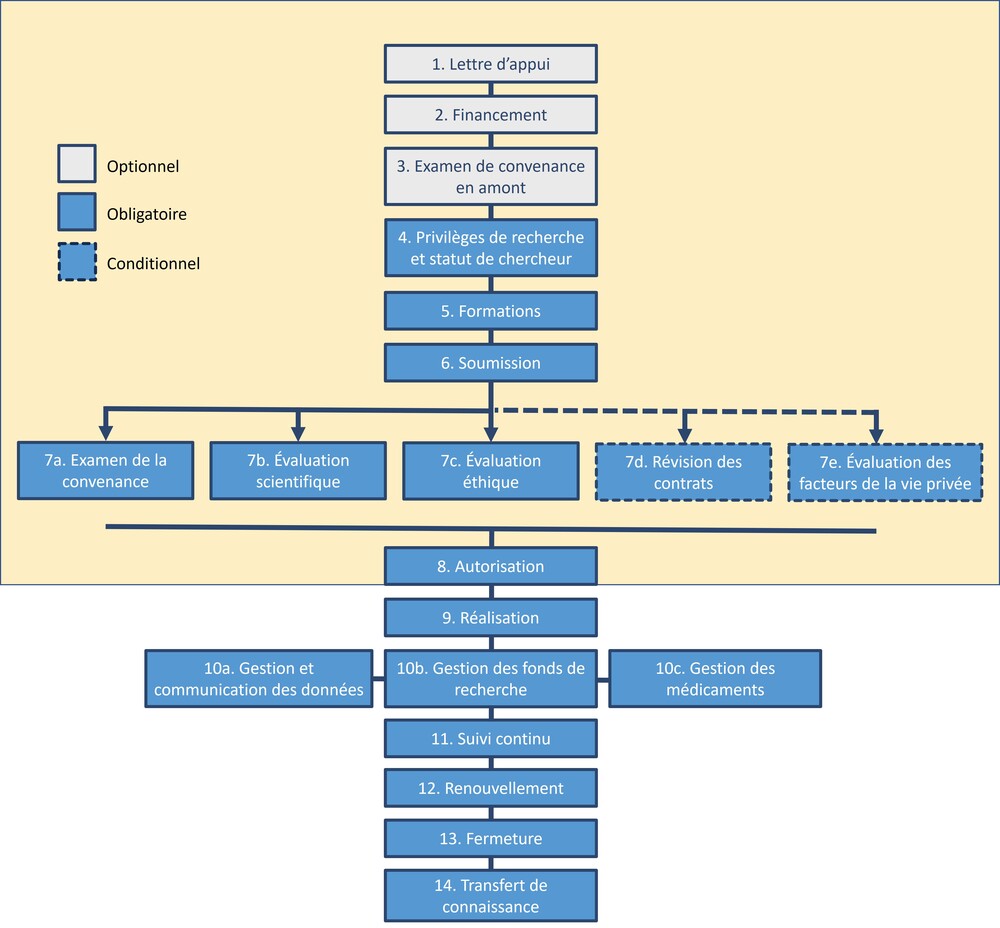
Steps for Preparing a Research Project up to Authorization
Click each step for more information in the original site
There is no official procedure to obtain a letter of support. Applicants may contact the signatory directly or the person designated by the directorate for research matters (see the list of convenience evaluators – coming soon).
Alternatively, requests may be sent to recherche.comtl@ssss.gouv.qc.ca at least two weeks before the deadline.
You must provide:
- Information about the funding agency
- The competition name
- Deadlines
- A draft letter
If the signatory is a senior executive, internal consultations may be required, so plan for more than two weeks.
A letter of support is not required to submit a project and does not constitute a convenience review, although it may speed up processing. It is not a final commitment from the signatory.
When a project receives funding, an account is opened at the affiliated research centre, McGill University, or elsewhere depending on the funder. Check with your research centre’s administration.
Research funds generally cannot be used until the project is approved by a health‑network Research Ethics Board (REB). Partial access to funds before ethics approval may be possible upon request (details to come).
A project does not need funding to be submitted for authorization. However, the REB may require justification if an unfunded project incurs expenses (e.g., participant compensation, paid services).
The convenience review normally begins when the project is submitted. However, CIUSSS stakeholders may review and accept the project before submission, known as an upstream convenience review. This is required for industry‑sponsored clinical trials, and strongly recommended for all other projects.
Researchers usually organize these consultations themselves. USER does not need to be informed.
If done upstream, the convenience review does not need to be repeated after submission, unless USER lacks sufficient proof of stakeholder support.
A letter of support for funding is not an upstream convenience review.
To conduct research in our CIUSSS or any health institution, a researcher must hold a researcher status issued by a health institution, or research privileges.
For procedures to obtain status or privileges, see the section Obtaining Research Privileges or Researcher Status.
For rules governing statuses and privileges, see the Policy on Obtaining Researcher Status or Research Privileges in the regulatory documents.
All researchers must complete the MSSS research ethics training (coming soon). This is required to obtain or renew research privileges.
All team members working on clinical trials must complete specific trainings (coming soon).
Other types of projects may also require or recommend certain trainings (coming soon).
The principal investigator is responsible for ensuring the team is properly trained.
Team members are encouraged to attend all available trainings, workshops, and presentations, especially those related to Nagano.
Researchers must log into the Nagano platform of the CIUSSS West‑Island‑of‑Montreal. Access must be granted even if the researcher already has Nagano access at another institution. Complete the Nagano Access Request Form and send it to recherche.comtl@ssss.gouv.qc.ca.
Before submitting, researchers should consult the section Rules applicable to research projects (coming soon).
Most projects are evaluated in full REB committee meetings, so submission before the posted deadlines is strongly recommended. These submission dates precede by three weeks the date of the sub-committee meetings and can be consulted in the section Guides, forms, and templates. The schedule of the INPLPP scientific committee is also there.
Projects are reviewed by USER and may be reopened if information is incomplete or unclear. The researcher must then answer the questions raised in order to complete the submission. It is therefore essential to answer the questions well and to read the guidelines carefully in order to avoid delays that could postpone the evaluation of the project by the REB.
Once the submission is deemed satisfactory, a letter entitled "Ready for Evaluation" outlining the submission and describing the upcoming evaluations is filed in the project folder in Nagano.
Before submitting, researchers must verify:
If this is the case, it is a multicentric project and our institution is a participating site. Our REB will not need to evaluate the project but it must nevertheless be submitted in order to be reviewed for appropriateness and possibly an RVP if access to information is requested. It must then be authorized.
The meetings of the two subcommittees are held on different dates. It is therefore important to carefully select the one that will evaluate your project in order to properly establish the deadline for submitting your project. If you are not sure which subcommittee to choose, contact recherche.comtl@ssss.gouv.qc.ca.
Only research projects are evaluated by the REB, but quality projects must be reported to the USER or the DQÉPÉ.
F11s vary depending on the type of project and it is essential that you use the right one, otherwise you may be asked to start your application again.
Banks and biobanks must comply with their own regulations that are important to consult. Their submission has particularities that we do not find with other types of projects.
Under a delegation agreement, INPLPP researchers' projects are evaluated by the Mental Health and Neuroscience subcommittee, but they must first be approved by their institution's scientific committee. The letter of approval from this committee must be attached to the documents submitted.
You must submit your project in these other institutions in order to obtain authorization and you must prepare your consent form to make it a network document if the project takes place in other health institutions.
The convenience reviews are normally initiated shortly after the beginning of the ethical evaluation and take up to 4 to 6 weeks to be completed, but may take longer under certain conditions, particularly if the information submitted is vague, incomplete, or inconsistent. For example, the applicant must avoid stating that nurses will help publicize the project while, at the same time, indicating in the section dedicated to convenience that no employee of the CIUSSS West‑Island‑of‑Montreal will participate in the project.
The start of the convenience review may be delayed if it is agreed that the project is likely to undergo substantial modifications following the REB evaluation, or if the directorates expected to collaborate on the project were never informed of it and the project requires significant contributions. In this regard, it is strongly recommended to discuss the project with the directorates at the time of its design in order to ensure, upstream, their participation. These discussions should not be limited to a service chief but must be validated by the person designated by the directorate to conduct convenience reviews. Please consult the section List of Directorates and Their Convenience Evaluators.
If the evaluation extends beyond ethical approval, the coordinator will follow up with the research team.
Please note that no letter is issued regarding the convenience review. The decision is mentioned in the final authorization letter as well as in the convenience module of Nagano.
The ethical evaluation of projects that present a risk or that involve a vulnerable population takes place during the full‑committee meeting of the subcommittee, held on fixed dates, whereas delegated evaluations are assigned to one or two REB members following submission. The procedures for these evaluations are described in the Catalis SOPs adopted by our Institution and can be consulted in our Regulatory Framework Documents section.
The REB’s response is normally issued between 5 and 10 business days after the meeting for full‑committee evaluations, and on average 25 days after submission for projects undergoing delegated review. These responses may be: approval, conditional approval, deferral, or refusal.
Please consult the Catalis SOPs in our Regulatory Framework Documents section under “ETHICS” to learn what steps must be taken following each of these decisions.
Please note that under these SOPs, researchers have 3 months to respond to the REB’s comments when required.
Please also note that multicentric projects that have been approved by another REB of a health institution do not need to be reviewed and approved by our REB; only the convenience review applies to these projects.
Comments related to ethics and science are included within the REB’s decision letters. Final approval requires a favorable evaluation for both ethics and science.
All the terms of the contractual agreements between the sponsors, the researchers, and the CIUSSS West‑Island‑of‑Montreal must be reviewed by the research centre administrations, and sometimes by Legal Affairs, in order to ensure their compliance and acceptability. The contract is reviewed at the same time as the other evaluations.
When the project is subject to such an agreement, you must submit it along with the research protocol, the budget, and any relevant information, including the contact details of the partner organization, to your research centre.
The contract or agreement is normally signed at the same time as, or after, the signature of the research project.
Any person who wishes to access and use personal information for the purposes of study, research, or the production of statistics, or to identify potential participants for a research project without the individuals’ consent, must indicate this in the F11 at the time the project is submitted.
Requests for a Privacy Impact Assessment (PIA/EFVP) are handled by the USER privacy lead, who will guide you through the process leading to approval of the request. This person will contact you after the project has been submitted. For a summary of the procedure established by the MSSS and a flow chart, please consult the document “Aide‑mémoire concernant la loi sur les renseignements de santé et de services sociaux ainsi que les EFVP – Pour les chercheurs.pdf” in the section Guides, Forms and Templates.
To proceed with a PIA/EFVP after the project has been approved by the REB, a modification request must be submitted to and approved by the REB, as explained in the section Follow‑up and Other Procedures After Authorization, after which the request will be handled by the person responsible for PIAs/EFVPs.
An authorization letter, signed by the person formally mandated, is uploaded to the project’s Nagano file once the project has received favorable responses for all its evaluations and once the principal investigator holds a researcher status or research privileges recognized by the CIUSSS West‑Island‑of‑Montreal. This letter authorizes the start of the project at the CIUSSS.
The conduct of the project at other sites may only begin once those other sites have issued and signed their own authorization letter.