A research project may begin once it has been authorized, but oversight continues, and several responsibilities fall to the research team. The REB is required to maintain continuous monitoring of the project and must be informed of any change made to the project or any deviation from the protocol. Researchers must submit reports regarding the progress of their project as well as a final report. They will also be approached to share the results they have obtained. All these steps are presented in this section.
Trajectory of a Research Project From Its Development to the Transfer of the Knowledge Produced
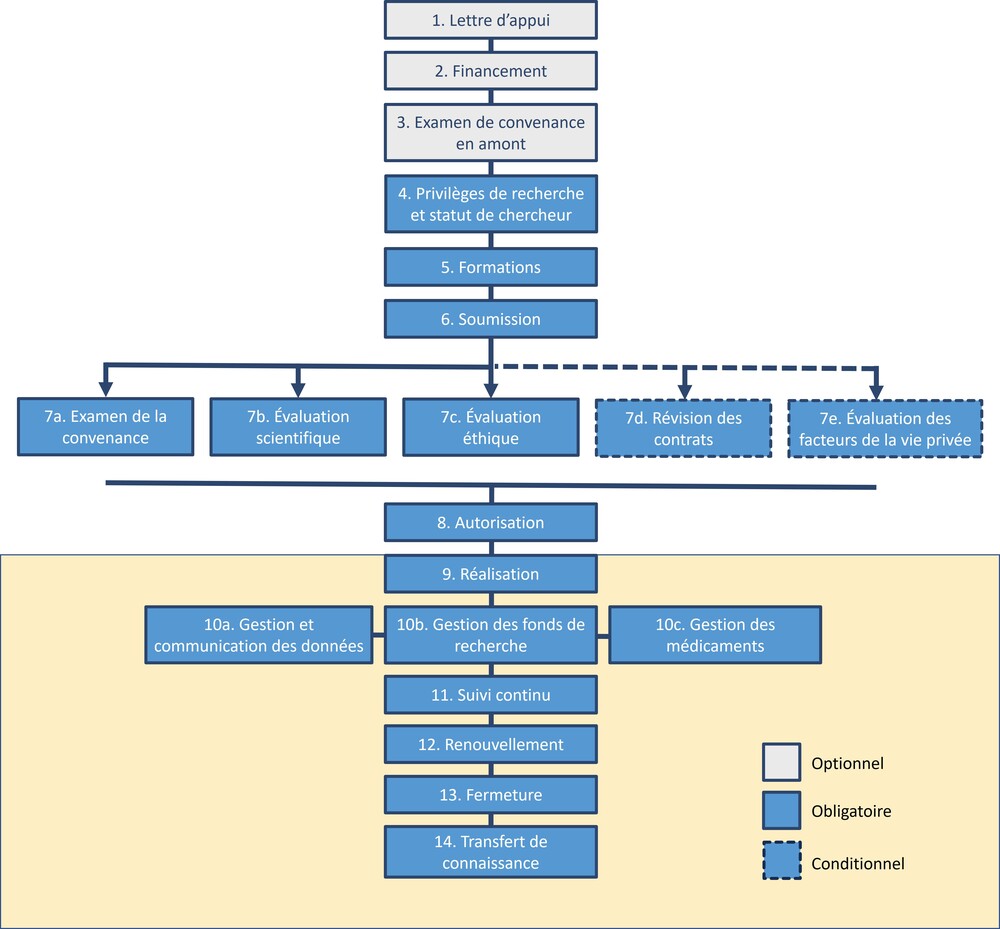
Steps Following the Authorization of a Research Project
Click each step for more information.
The conduct of a research project, once authorized, is entirely the responsibility of the research team. It is the responsibility of the principal investigator to contact the partners of the CIUSSS West‑Island‑of‑Montreal (if needed, consult the list of convenience evaluators, who are also the points of contact for research) and the service units, if applicable. USER nevertheless remains available to assist research teams at any time.
If the project is a data bank or a biobank, the management framework submitted to the REB and approved by it must be strictly followed. If the project feeds a data bank or a biobank, its management framework must be followed. For more information, please consult the Guidelines on Data Banks and/or Biological Material Banks Established for Research Purposes in the Regulatory Framework Documents section.
The list of participants and certain information about them must be continuously updated according to conditions dictated by the ministerial reference framework. The rules concerning this list are presented in the Procedure for Identifying Research Participants for Protection Purposes in the Regulatory Framework Documents section.
The retention and destruction of data must comply with the standards in this area. To this end, a retention schedule has been prepared specifically for research data and can be consulted in the Regulatory Framework Documents section. Please ensure that you follow it.
Please consult the section Rules Applicable to Personal Information and Research Data (coming soon) for more information regarding the rules that must be followed concerning research data.
Researchers are responsible for complying with the conditions governing the use of funds. Certain documents on this topic are available in the Regulatory Framework Documents section.
More information to come.
More information to come.
The researcher is responsible for notifying the REB of any modification they wish to make to the protocol, of any deviations, and of any serious adverse events affecting participants; otherwise, they risk being subjected to an evaluation for breach of responsible conduct.
Modifications—whether they involve adding participants, changing a recruitment advertisement, removing a co‑investigator, etc.—must be reported to the REB using the F1 form in Nagano. The rules presented in SOP MON‑CER 404‑002 in the Regulatory Framework Documents section under “ETHICS” will be applied.
The modification is generally reviewed through a delegated process, but it may be placed on the agenda of a full REB meeting if the modification changes the level of risk for participants.
The request is subject to an accelerated convenience review if the modification affects the CIUSSS’s participation requirements, such as adding a facility to the project or increasing the number of participants. The researcher will be notified if this applies. A new authorization letter is not issued when convenience is approved, but if the researcher needs one or wishes to obtain an updated authorization letter, they must request it at recherche.comtl@ssss.gouv.qc.ca.
Beyond modifications made to the protocol, the following must be reported to the REB:
Plus d'information à venir.
Voir le MON-CER 404-002 à la section Documents du cadre réglementaire sous 'ÉTHIQUE'
Plus d'information à venir.
Voir le MON-CER 404-002 à la section Documents du cadre réglementaire sous 'ÉTHIQUE'.
Plus d'information à venir.
Voir le MON-CER 105B-002 à la section Documents du cadre réglementaire sous 'ÉTHIQUE'.
Ethical approvals have a limited duration, generally one year. To continue the project beyond this period, an annual report must be submitted and the ethical approval must be renewed. The submission of these reports, far from being a simple administrative measure, is a process that allows the REB to ensure that the project’s progress meets the expectations set by the REB, that no issues have been encountered, and that ethical and scientific approvals can be renewed.
The renewal request is made using the F9 form in Nagano, and the procedure to follow is described in SOP MON‑CER 405‑002 in the Regulatory Framework Documents section under “ETHICS.” The ideal time to submit the request is one month before the end of the project’s ethical approval period.
The F9 must be properly completed and must be consistent with the F9 from the previous year in order to avoid unnecessary processing delays. The figures related to recruitment must also be consistent with one another.
Two reminder messages are sent to the principal investigator, but it is ultimately the investigator’s responsibility to ensure the renewal of their projects. It is important to note that in some cases, notifications may be captured as spam, but this cannot justify a delay in renewal. See the memo on this topic for more information.
Any project that has not been renewed before the expiration date of its ethical approval must automatically be suspended, which means that research activities must cease on that date. A letter is sent to the researcher in this regard. A copy of the letter is also sent to the researcher’s affiliated research centre, the convenience evaluators, and the budget manager.
The principal investigator officially closes their project when it is completed by using the F10 form in Nagano, in accordance with SOP MON‑CER 407‑002 in the Regulatory Framework Documents section under “ETHICS.”
Just like the renewal of ethical approval, the closure of a project is not a simple administrative measure but rather a report that allows the REB to take note of the activities carried out as part of the project since its last renewal or since its initial authorization.
If a project has still not been closed once its ethical approval has expired, the project is suspended, and the researcher may no longer submit a new project in the meantime unless they have a justification deemed acceptable by the REB.
If the REB ultimately has to close the project itself after several months because the researcher does not respond to the REB’s requests, the REB may ask the researcher for explanations when they submit a new project.
A knowledge transfer plan is written in the F11. If this plan involves the participation of the Tc‑Inno service, contact them in order to set the plan in motion.
You may be approached to produce a summary of your results, using a form (to come) or to give a presentation for the units and departments that participated in the project. This gesture is a sign of respect and appreciation for the time that participants devoted to the project. It helps highlight the project and the relevance of participating in research.
The Douglas Research Centre adheres to five guiding principles for open science and ensures their implementation. To learn more, please consult their webpage Open Science at Douglas.